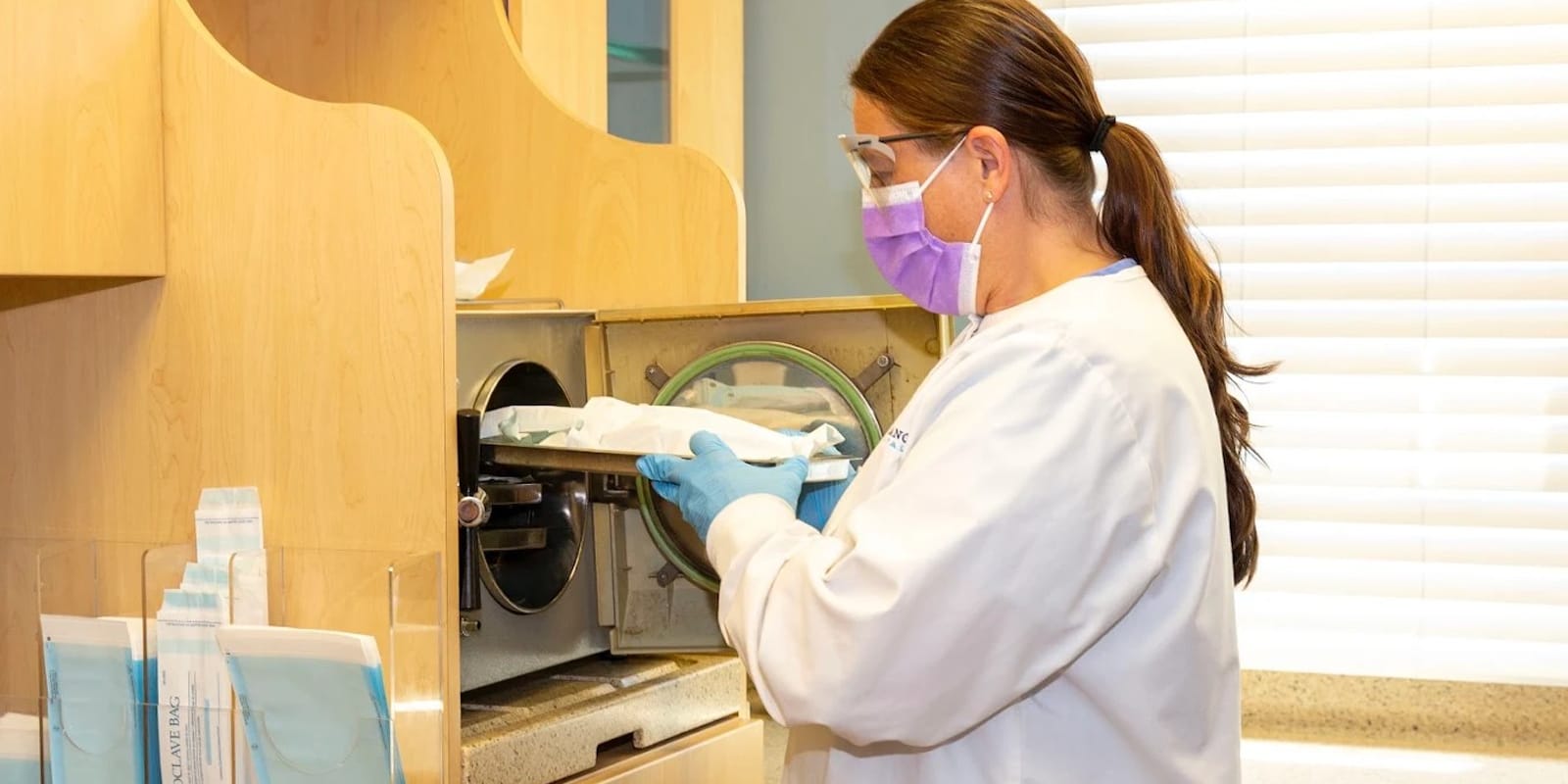

A regular cleaning removes plaque and tartar from above the gum line. A deep cleaning — scaling and root planing — goes beneath it, cleaning the root surfaces inside gum pockets and smoothing them so the gum can reattach to the tooth.
NEEDS SIGN-OFF K-04 Claims about the practice — Deep cleaning / scaling & root planing in-house. Approve as written, or give the correction.
They are not two grades of the same service. They are different procedures for different conditions, and one of them treats a disease.
How to tell whether you actually need one
People are suspicious of being told they need a deep cleaning, and honestly, they are right to ask. So here is how to check.
Ask for your pocket depths. During an examination, a small probe measures the gap between gum and tooth, in millimetres, at several points around every tooth. It does not hurt. The numbers are called out and written down.
- 1–3 mm: healthy. A regular cleaning is what you need.
- 4–5 mm: early gum disease. A brush cannot reach the bottom of that pocket, and neither can a regular cleaning.
- 6 mm and above: established disease, with bone loss.
Ask to be told the numbers. Ask whether the gums bled while being probed. Ask to see the X-rays showing the bone level. A dentist recommending a deep cleaning should be able to show you all three in about two minutes.
If they cannot, get a second opinion. And if they can, believe them — because the alternative is losing teeth, and gum disease, not decay, is the leading cause of tooth loss in adults.
What each one involves
A regular cleaning takes about forty-five minutes. Hardened tartar is removed from the visible surfaces of the teeth, above the gum line, and everything is polished. No anaesthetic.
A deep cleaning is done under local anaesthetic, usually over two visits, half the mouth at a time. Tartar is removed from the root surfaces inside the pockets, below the gum, where a brush has never been able to reach. The root is then smoothed so that bacteria have less to cling to and the gum has a chance to reattach.
You may be sore for a day or two afterwards, and your teeth may be sensitive to cold for a few weeks as the inflamed gum tightens back down.
What it costs
NEEDS SIGN-OFF C-02, C-15 Costs stated here — routine cleaning + exam $180–$300; deep cleaning, per quadrant $300–$450. Approve as written, or give the correction.
- Regular cleaning and exam: $180 to $300 in this area
- Deep cleaning: $300 to $450 per quadrant, and most people need two to four quadrants
Here is the useful part: unlike cosmetic work, gum treatment is generally covered at least in part by dental plans, because it treats disease. Radiant Smiles is currently out-of-network with most plans, and we will work out what yours contributes before you start.
The part that decides everything, and it is not the cleaning
Gum disease is chronic. It is controlled, not cured.
A deep cleaning resets the situation. What holds it is what happens afterwards: maintenance visits every three or four months rather than every six, because the pockets refill faster in a mouth that has had gum disease than in one that has not.
Patients who do this keep their teeth. Patients who have the deep cleaning, feel better, and then disappear for two years are back where they started — and poorer, because they paid for the deep cleaning and then discarded it.
If you take one thing from this article, take that. The deep cleaning is the down payment. The maintenance is the treatment.
And the line you do not want to cross
Gingivitis — inflamed gums, bleeding, bone intact — is completely reversible. Treat it and it goes away.
Periodontitis — the infection reaching the bone — is not. Bone that has been lost does not come back. Treatment stops the loss and holds the line; it cannot rebuild what has gone.
Which is the entire argument for coming in when your gums bleed, rather than when your teeth start to move.
Questions people ask
Is a deep cleaning just an upsell?
It can be, and that is worth saying out loud. The defence against it is simple: ask for your pocket depths, ask whether the gums bled, and ask to see the bone level on the X-ray. Real gum disease is visible and measurable, and a dentist should be able to show you.
Does it hurt?
The area is numbed. Afterwards, expect soreness for a day or two and cold sensitivity for a few weeks.
Why can't I just brush harder?
Because the tartar is below the gum line, it is hardened, and it is bonded to the root. No brush removes it. Brushing harder damages the gum and makes recession worse.
Will my gums grow back?
The inflammation resolves and the gum tightens back against the tooth. But if the gum has receded, it does not regrow, and if bone has been lost, it does not return.
How often will I need this?
The deep cleaning itself, ideally once. The maintenance visits, every three to four months, indefinitely.
---
Bleeding gums are not normal, and caught early this is completely reversible. Gum disease treatment in Bridgeport, or call (203) 372-0881.
Educational, not a diagnosis.