
Gum Disease Treatment in Bridgeport, CT
Bleeding or swollen gums are usually the first sign of gum disease. Radiant Smiles treats it in Bridgeport with a deep cleaning — scaling and root planing — followed by a maintenance schedule that holds the result. Dr. Jasmeet Kaur, D.D.S., 2240 Madison Avenue.
NEEDS SIGN-OFF K-04 Claims about the practice — Deep cleaning / scaling & root planing in-house. Approve as written, or give the correction.
If your gums bleed when you brush, this page is for you, and the timing matters more than you think.


Bleeding gums are not normal
Skin does not bleed when you wash it. Gums should not bleed when you brush them.
Bleeding means inflammation, and inflammation means plaque and hardened tartar sitting somewhere a toothbrush cannot reach — usually just below the gum line, in the narrow space between the gum and the tooth. Your body is responding to a bacterial infection, and the bleeding is the response.
The instinct almost everyone has — to brush that area more gently, because it hurts and it bleeds — is exactly backwards. It needs to be cleaned properly, by us, and then kept clean by you.
Caught at this stage, it is completely reversible. That is the whole reason to come in now.

The line you do not want to cross
There are two stages, and the difference between them is permanent.
Gingivitis is inflammation of the gum only. The gums are red, swollen and bleed easily, but the bone holding the teeth in is intact. Treat it and it goes away, entirely.
Periodontal disease is what gingivitis becomes when it is left. The infection reaches the bone, and the bone begins to dissolve away from the teeth. Pockets form. Gums recede. Teeth loosen, drift, and eventually fall out — and gum disease, not decay, is the leading cause of tooth loss in adults.
Bone that has been lost does not come back. Treatment stops the loss and holds the line. It cannot rebuild what has already gone.
Which is the entire argument for coming in when your gums bleed, rather than when your teeth move.

What treatment involves
NEEDS SIGN-OFF K-04 Claims about the practice — Deep cleaning / scaling & root planing in-house. Approve as written, or give the correction.
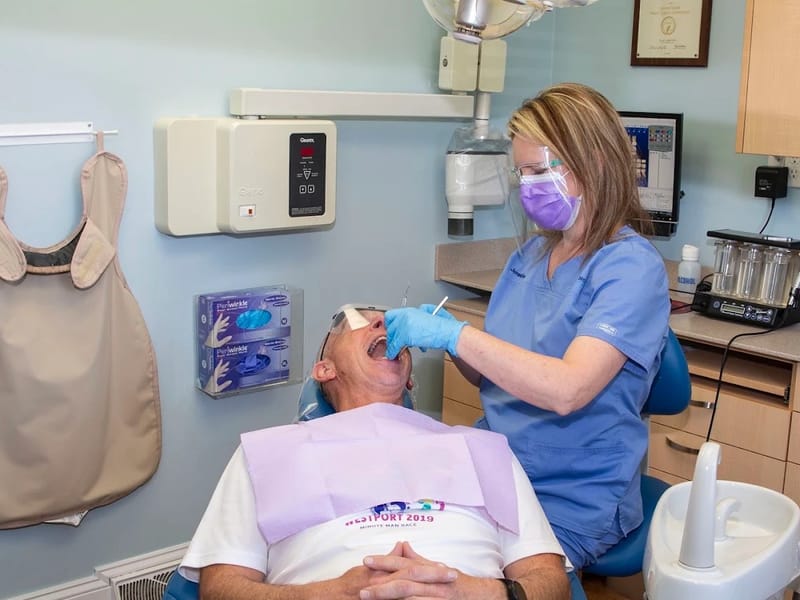
A deep cleaning — scaling and root planing. A regular cleaning works above the gum line. This one goes beneath it: plaque and hardened tartar are removed from the root surfaces inside the pockets, and the roots are smoothed so that the gum can reattach to the tooth. The area is numbed, and it is usually done over two visits, half the mouth at a time.
Then maintenance, and this is the part that decides everything. Gum disease is chronic. It is controlled, not cured, and control means coming back every three or four months rather than every six — because the pockets refill faster than a healthy mouth does. Patients who do this keep their teeth. Patients who have the deep cleaning and then disappear for two years are back where they started, and poorer.
Where the disease is advanced, surgical treatment may be needed and Dr. Kaur will refer you to a gum specialist. She will tell you when that point has been reached rather than repeat a treatment that is not working.
Your general health
There is a well-documented association between gum disease and heart disease, diabetes and poor pregnancy outcomes.
Honest dentistry does not overstate it: association is not causation, and no one should tell you that a deep cleaning will fix your heart. What is clear is that gum disease is a chronic bacterial infection in your body, that diabetes and gum disease each make the other harder to control, and that treating it is worth doing on its own terms.
If you are diabetic, tell us. It changes how closely we watch this.
What you have to do at home, and why it is not optional
We can clean below your gum line twice a year. You are in charge of the other three hundred and sixty-three days, and gum disease is won or lost in those.
Clean between the teeth, daily. Floss, interdental brushes, a water flosser — whichever you will actually use, because the best technique is the one you do. Brushing alone cleans about three-fifths of each tooth. Gum disease lives in the other two-fifths.
Brush at the gum line, not away from it. Angle the bristles into the join between tooth and gum. That junction is where the disease is, and it is the exact spot most people skip because it is tender.
Bleeding is not a reason to stop. It is a reason to keep going — bleeding gums stop bleeding within a fortnight of being cleaned properly. Backing off keeps them inflamed indefinitely.
And if you smoke, this is the conversation. Smoking is the single strongest modifiable risk factor for losing your teeth to gum disease, and it also masks the bleeding that would have warned you.

What it costs — and the good news
NEEDS SIGN-OFF C-15, K-04 Costs stated here — deep cleaning, per quadrant $300–$450. Claims about the practice — Deep cleaning / scaling & root planing in-house. Approve as written, or give the correction.
In this area, scaling and root planing typically runs $300 to $450 per quadrant, and most people need two to four quadrants treated.
Here is the useful part: unlike cosmetic work, gum treatment is generally covered at least in part by dental plans, because it treats disease. Radiant Smiles is currently out-of-network with most plans, and we will work out what yours contributes before you start. How the out-of-network side works.
Gums bleeding? Call (203) 372-0881.
Ranges, not quotations. What your treatment costs depends on what you actually need, and you will be given a firm figure after an examination — before anything begins.
Related care

Family & General Dentistry
Cleanings, exams, X-rays, fillings and preventive care for children and adults, in one office on Madison Avenue. Accepting new patients.
Learn more
Dental Implants
A titanium post replaces the root of a missing tooth and carries a custom crown. Placed and restored in-house by Dr. Kaur. Firm quote after an X-ray.
Learn more
Dentures
Full and partial dentures, plus adjustments, relines and repairs. Dr. Kaur reviews fit, cost and implant-supported alternatives at a consultation.
Learn moreFrequently asked questions
Why do my gums bleed when I brush?
What is a deep cleaning?
How much does a deep cleaning cost?
The long answer: Deep Cleaning vs. Regular Cleaning — What's the Difference?
Can gum disease be reversed?
Is gum disease linked to other health problems?
Book with a dentist who will tell you when you do not need the treatment
Dr. Jasmeet Kaur, D.D.S. publishes her cost ranges, explains the cheaper option first, and says plainly when the honest answer is to do nothing. Accepting new patients, including children.